The short answer: the time to build an electrician website ranges from 7 days to 3 months, depending on who builds it and how quickly you supply photos, services, and approvals. A managed service can go live in 7–10 days. A freelancer usually needs 4–8 weeks. DIY takes as long as your free evenings allow.
This post walks through every phase of a website build — discovery, content gathering, design, development, review, and launch — so you know exactly what takes time, what can be fast, and where projects usually stall. It’s written for Dutch electricians and small trade businesses who want realistic expectations, not marketing promises.
Before you start: what you’ll need
Every electrician website build — regardless of route — needs the same raw materials from you. Gathering these in advance is the single biggest thing that speeds up a quick website electrician project.
- Basic business info — company name, KvK number, VAT (BTW) number, service area, contact details
- Services list — what you do (groepenkast, laadpaal, verlichting, etc.) and what you don’t
- Photos — 8–15 real photos of your team, van, completed jobs (not stock images)
- Reviews — Google reviews or written testimonials from past customers
- Logo — if you have one; if not, most providers can make a simple wordmark
- Domain name — e.g. yourname-elektrotechniek.nl (existing or new)
- Login for your Google Business Profile — if you already have one
If you have these ready on day one, every route below gets noticeably faster.
The 6 phases of building an electrician website
Every website build — DIY, freelancer, or managed — goes through the same six phases. What changes is who does each phase and how long it takes.
1. Discovery (understanding what the site needs to do)
What happens: You clarify who the site is for (local homeowners, business clients, apprentices), what you want it to do (get enquiries, bookings, job applications), and which services matter most.
How long it takes:
- DIY: 1–3 hours of thinking and notes
- Freelancer: 1–2 meetings across 1–2 weeks
- Managed service: 20–40 minute intake call or form
Where it stalls: If you haven’t decided whether the site is mainly for getting customers, getting staff, or both, discovery gets circular. Decide before you start.
2. Content gathering (photos, copy, services)
What happens: You collect photos, write or approve service descriptions, and provide reviews. This is the phase almost every project underestimates.
How long it takes:
- DIY: As long as you’re willing to spend. Most owners stall here for weeks.
- Freelancer: 1–3 weeks, depending on how fast you send materials
- Managed service: 2–5 days, because providers work with what you send and draft the rest
Where it stalls: Real photos are the bottleneck. Writing service descriptions from scratch is the second bottleneck. Managed services solve both by using templates you approve rather than starting from blank pages.
3. Design (how the site looks)
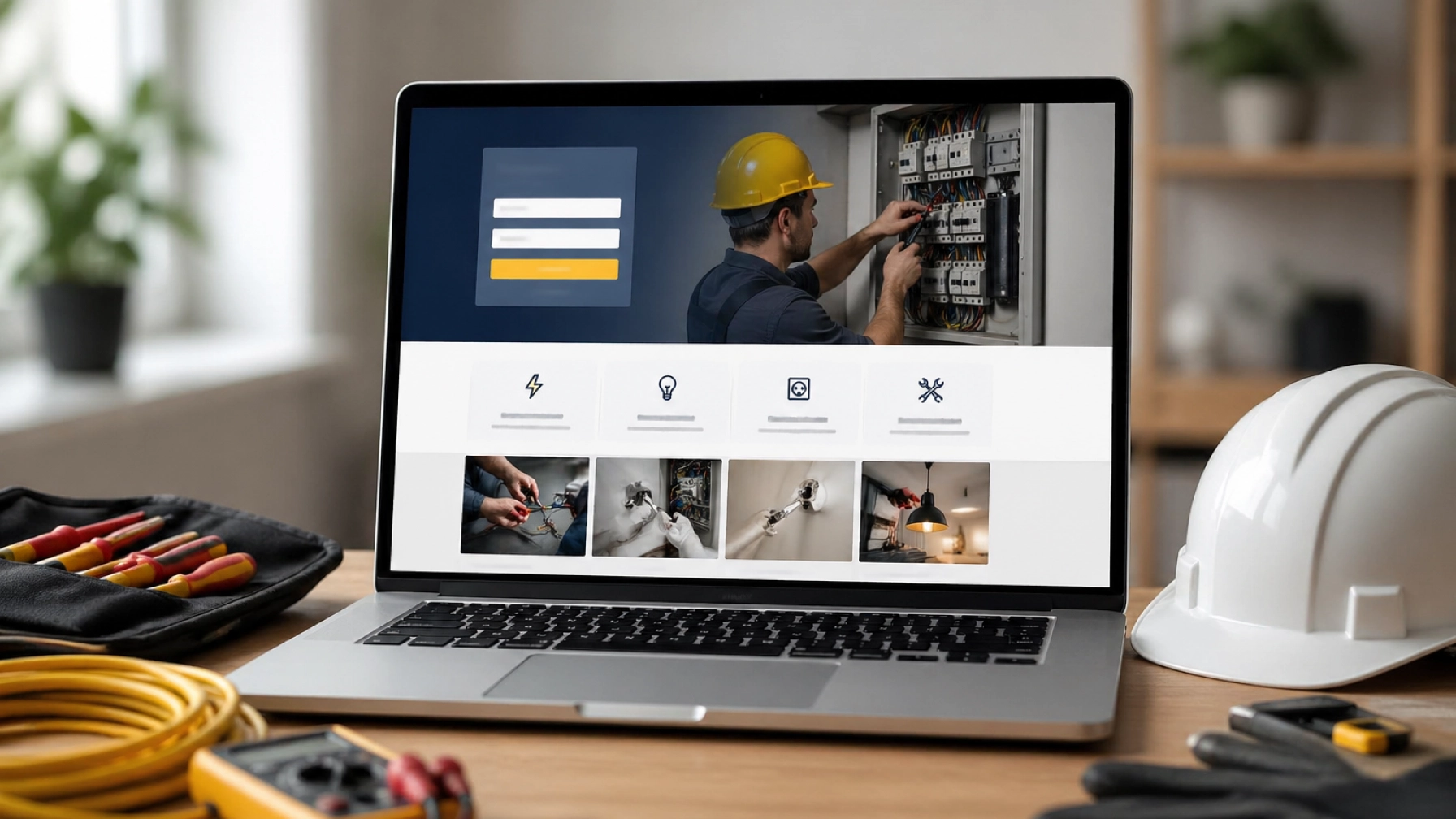
What happens: Colors, fonts, layout, navigation, and the overall look of the site get set. Most electrician sites follow a proven structure — hero image, services grid, reviews, contact.
How long it takes:
- DIY: 1 day to 2 weeks, depending on template choices and perfectionism
- Freelancer: 1–3 weeks, including 1–2 rounds of revisions
- Managed service: 1–2 days, because the provider uses proven templates for trades
Where it stalls: Freelancer projects often stall here when clients request multiple rounds of revisions. Every revision round adds 3–5 days. Managed services avoid this by offering fewer but faster design choices.
4. Development (building the actual site)
What happens: The design gets turned into a working website. Pages are built, forms are connected, hosting is set up, and the domain is pointed to the new site.
How long it takes:
- DIY: 1–4 weeks, depending on the platform and your comfort level
- Freelancer: 2–4 weeks, including custom functionality
- Managed service: 1–2 days, because the technical setup is standardised
Where it stalls: For DIY, plugin conflicts and broken themes are the main delays. For freelancers, waiting on login details (domain registrar, email, Google accounts) is the common block.
5. Review and approval
What happens: You look at the site, test it on your phone, check every service description, and request changes. This is where you catch mistakes before customers do.
How long it takes:
- DIY: Ongoing — there’s no external deadline
- Freelancer: 3–7 days, often with 1–2 revision rounds
- Managed service: 1–3 days, with small tweaks handled quickly
Where it stalls: Busy owners often say “I’ll check it this weekend” and the project waits. A good review takes 30 minutes, not three weekends. Block the time and do it in one sitting.
6. Launch (going live)
What happens: The site is pointed to your domain, Google Business Profile is connected, and the site becomes visible on the internet.
How long it takes:
- DIY: A few hours, if DNS is straightforward
- Freelancer: 1 day, sometimes 2 if waiting on domain access
- Managed service: Same day — part of the standard process
Where it stalls: Domain transfers and DNS changes can take up to 48 hours to propagate. This is normal and outside anyone’s control.
Side-by-side: how long each route takes
Here’s the full timeline across the three main routes. These are realistic ranges, not best-case promises.
| Phase | DIY (Wix / WordPress) | Freelancer | Managed Service |
| Discovery | 1–3 hours | 1–2 weeks | 20–40 minutes |
| Content gathering | 1–8 weeks | 1–3 weeks | 2–5 days |
| Design | 1 day – 2 weeks | 1–3 weeks | 1–2 days |
| Development | 1–4 weeks | 2–4 weeks | 1–2 days |
| Review | Ongoing | 3–7 days | 1–3 days |
| Launch | Same day | 1 day | Same day |
| Total (realistic) | 3 weeks – 3 months | 4–8 weeks | 7–10 days |
Why a 7-day managed website build is possible — and where Growth Rocket fits in
A 7-day launch sounds aggressive until you see what’s actually pre-built before you ever start. The reason a managed service like Growth Rocket can hit that timeline isn’t speed for its own sake — it’s because the slow parts of a typical project have already been solved upstream, leaving only the parts that genuinely need your input.
What Growth Rocket has done before day 1:
- A proven page structure built specifically for Dutch electricians — homepage, services, service area, reviews, contact — tested against what actually converts for trades
- Mobile-responsive templates already QA’d on real phones, not just resized in a browser
- Enquiry and booking forms wired into a backend that emails and SMSs you the moment a lead comes in
- Hosting, SSL, basic on-page SEO, and Google Business Profile integration set up as standard
- A content framework so you approve drafts instead of writing service descriptions from a blank page
Why this matters for you as an electrician:
- You don’t lose billable days. The whole process needs about 2 hours of your time, not two weeks of evenings.
- You get a site built for your trade, not a generic small-business template. Service area pages, laadpaal/groepenkast/verlichting structures, and review placement are already mapped out.
- You stop paying for “discovery.” No multi-meeting kickoff — a 20–40 minute intake and you’re moving.
- One predictable monthly fee covers hosting, updates, and small changes instead of a €3,000+ upfront invoice and surprise maintenance bills later.
- You’re not stuck if something breaks. Managed means someone fixes it; freelancer means waiting on a reply.
What still needs you (and there’s no shortcut here):
- Sending your logo, photos, and services within 24–48 hours of kickoff
- Reviewing the draft and sending one consolidated batch of changes — not five trickling rounds
- Giving access to your domain when asked
If you take a week to reply to emails, no service can launch in 7 days. Speed is a two-way commitment — Growth Rocket has removed every delay on the provider side, so the only variable left is you.
When 7 days won’t work
Be realistic. A 7-day Growth Rocket build doesn’t apply if:
- You want a fully custom design instead of a proven template-based structure
- You’re waiting on a new logo from a separate designer
- Your domain is held by an old IT person you can’t reach
- You need multi-language from day one (this can be added in phase 2)
In those cases, plan for 2–3 weeks. That’s still fast by freelancer standards — and still cheaper over 12 months than a one-off custom build.
FAQ
Q1. How fast can an electrician website actually be built?
A managed service can go live in 7–10 days if you supply materials quickly and respond to reviews within 24 hours. A freelancer typically takes 4–8 weeks. DIY ranges from 3 weeks to 3 months depending on how much free time you have.
Q2. What’s the fastest website launch for tradespeople?
A managed subscription service like Growth Rocket. The provider uses pre-built templates designed specifically for trades and handles hosting, forms, SEO, and Google Business setup as part of the standard process. Typical launch with a responsive client: 7 days.
Q3. Why does a freelancer take 4–8 weeks?
Because every freelancer project is custom. That means more discovery meetings, more design rounds, and more back-and-forth on revisions. Each revision round adds 3–5 days. It’s not inefficiency — it’s the inherent cost of building bespoke. The trade-off for getting a site exactly how you want it is that you wait 6 weeks instead of 7 days.
Q4. Can I get a website up in a weekend?
Technically yes, with Wix or Squarespace and a template. The site will exist by Sunday night. But it usually won’t rank locally, won’t have proper enquiry handling, won’t include reviews or photos that build trust, and won’t be connected to your Google Business Profile. A weekend gets you a placeholder, not a working business tool. If your goal is leads, this route almost always costs more in lost work than it saves in build fees.
Q5. What slows down most electrician website projects?
Content gathering — specifically getting real photos and deciding on services. Most projects stall for weeks at this stage because owners are busy on jobs. Gathering materials before the project starts cuts the timeline in half.
Q6. Do I need to take time off work to get a website built?
No. A managed service needs about 2 hours of your time total, spread across 7–10 days. A freelancer project typically asks for 4–6 hours of your time over 6 weeks. DIY is the only route that realistically requires dedicated time off.
Final word
A working electrician website isn’t a 3-month project unless you make it one. The six phases are the same for everyone — what changes is how much of each phase you handle yourself and how quickly you respond.
If you want it done fast, the recipe is straightforward: pick the route that matches your time (DIY if you have evenings, freelancer if you have a clear custom brief, managed if you want it handled), gather your materials up front, and block time for review.
Seven days is achievable. Two months is common. Which one you end up with depends less on the builder and more on you.