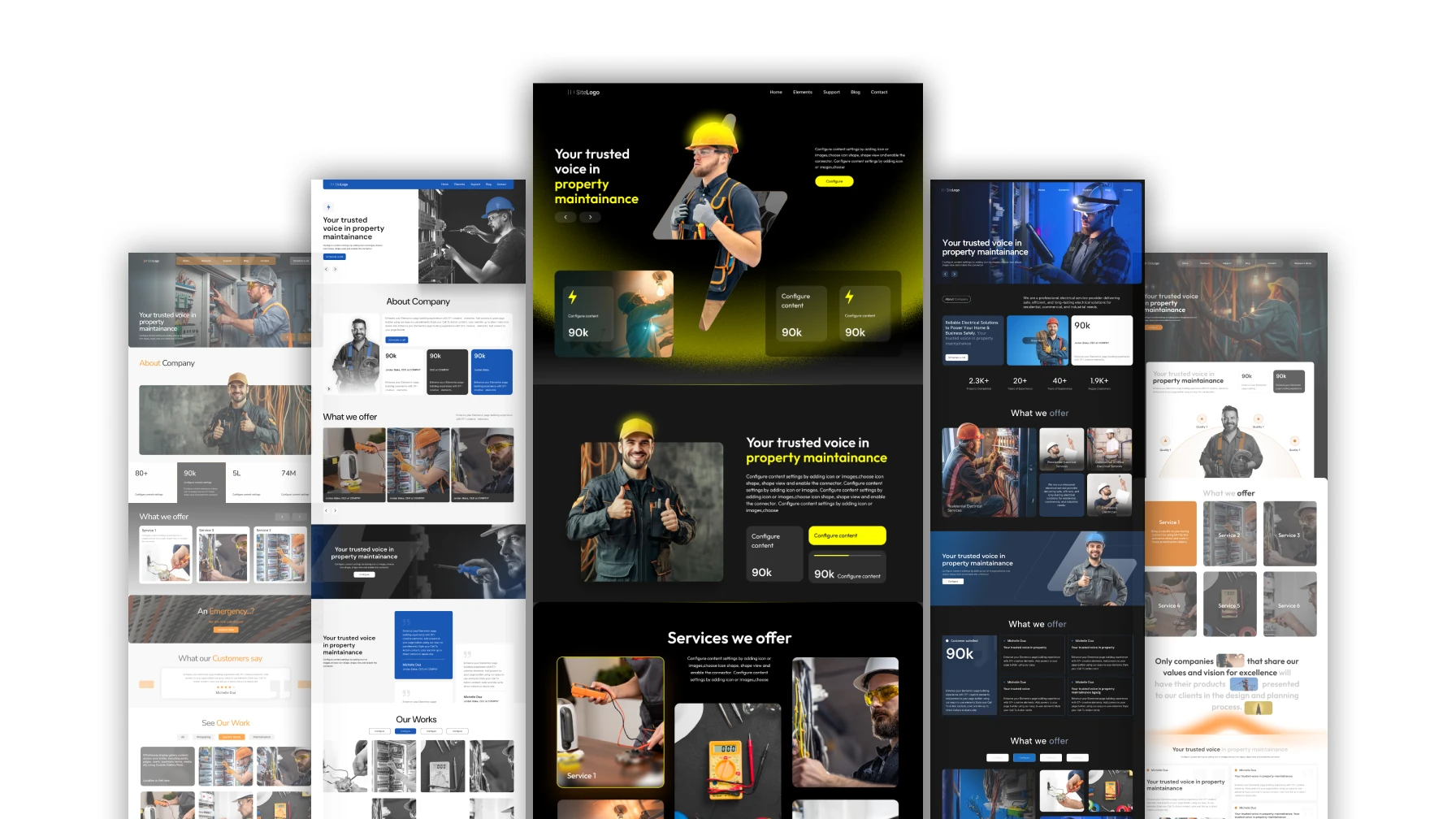
If you run a small electrical business and want to see what good actually looks like, this guide walks through eight electrician website examples — Dutch and international — and breaks down what each one does well. We’ve kept the names anonymous and grouped them by approach, so you can pick the patterns that fit your business.
A good electrician website doesn’t need to be flashy. It needs to do three things: explain what you do, prove you can be trusted, and make it easy to get in touch. The examples below show different ways to get there.
How We Picked These Examples
We reviewed dozens of electrician websites across the Netherlands, Belgium, Germany, the UK, and North America. The eight examples here were selected based on five criteria:
- Hero clarity — does the homepage tell you what they do in under five seconds?
- Service presentation — are services structured, scannable, and locally relevant?
- Trust signals — reviews, certifications, real photos of real people
- Photography and visual quality — original, on-the-job photos rather than stock
- Navigation and contact — how easy it is to call, message, or request a quote
We also looked for honest trade-offs. No website is perfect, and we’ve called out where each example falls short, so you can avoid copying the weak parts.
1. The Local Specialist: A Family Electrical Business in Utrecht
A small two-person electrical company in Utrecht with a homepage that opens with a single line: “Erkend elektricien in Utrecht en omgeving — bereikbaar binnen 24 uur.” Below it, a phone number and a WhatsApp button.
What it does well:
- The hero answers three questions instantly: who, where, how fast.
- Two contact options above the fold: phone and WhatsApp. No friction.
- The “About” section uses real photos of the father-and-son team in their work van. Not stock.
- Reviews are pulled in from Google with the date and the customer’s first name visible.
What to watch out for:
- The service pages are thin. Each service has only two or three sentences, which limits SEO and leaves visitors with questions.
- No clear pricing guidance, even ranges. Visitors who want a sense of cost have to call.
Ideal for: Solo operators and two- to three-person teams who win on local trust and speed. If your business is built on word-of-mouth in a specific area, this is the cleanest pattern to copy.
2. The Service-Led Site: A Mid-Size Electrical Contractor in Rotterdam
A ten-person company that focuses on residential renovations and small commercial work. Their site is structured around services, with a dedicated page for each one.
What it does well:
- Eight clearly named service pages: Groepenkast vervangen, Laadpaal installeren, Stroomstoring, Elektra aanleggen, and so on.
- Each service page follows the same structure: what’s included, how long it takes, what to expect, FAQ.
- The “Stroomstoring” page has a prominent emergency call button and a typical response time stated in plain language.
- Strong internal linking — every service page links to two or three related services.
What to watch out for:
- The homepage is busy. Three sliders, a long services grid, and a testimonial block all fight for attention.
- The FAQ sections are written in marketing language rather than how a customer would actually phrase the question.
Ideal for: Established firms (5–20 employees) targeting commercial intent keywords. If you want to rank for terms like “laadpaal installeren [city]” or “groepenkast vervangen,” this service-led structure is the right model.
3. The Trust-First Site: A UK-Based Family Electrician
A British electrical company whose entire homepage is built around trust. Above the fold: NICEIC certification badge, Trustpilot rating, years in business, and a postcode checker.
What it does well:
- Five trust signals visible without scrolling: certification, review score, years operating, insurance proof, and a “Which? Trusted Trader” badge.
- The team page shows every electrician with a photo, full name, certifications, and years on the job.
- Customer reviews include the type of job and the location, which makes them feel verifiable.
- A short video on the homepage — under 30 seconds — shows the owner walking through a recent job.
What to watch out for:
- The site is heavy. Page load is slow on mobile, partly because of the autoplay video.
- Some trust badges link to certificates from previous years. Outdated proof can hurt more than help.
Ideal for: Electricians in markets where consumer trust is fragile — particularly anywhere there’s been a rise in fraudulent or fly-by-night operators. If you want to differentiate yourself as the legitimate choice, lead with proof.
4. The Niche Specialist: An EV Charging and Solar Installer in Amsterdam
A specialist firm that installs only EV charging stations and home batteries. Their website looks more like a tech product page than a traditional trades website.
What it does well:
- The hero focuses on one outcome: “Een laadpaal die past bij jouw auto, huis, en stroomnet.”
- A short calculator on the homepage asks three questions (car model, parking situation, current fuse box) and returns a price range.
- Brand logos of charger manufacturers they’re certified to install — instant credibility.
- Case studies with before/after photos and the actual install time.
What to watch out for:
- The site is so specialized it would confuse customers looking for general electrical work.
- The calculator is impressive but only works for the most common scenarios. Edge cases dump people back to a generic contact form.
Ideal for: Specialists who serve a single high-value niche. If you’ve decided to focus on EV charging, solar, or home batteries, a deep specialist site converts far better than a generic electrician page.
5. The Quote-Wizard Site: A German Electrician in Hamburg
A small German electrical company that’s built its entire homepage around a multi-step quote request. The form takes about 90 seconds and asks for service type, urgency, address, and a photo upload.
What it does well:
- The quote wizard replaces the generic “Contact Us” form with structured intake.
- Customers can upload a photo of their fuse box or the problem area, which saves the electrician a site visit.
- Progress indicator shows how many steps are left — clear and unintimidating.
- A confirmation page sets expectations: “We reply within 4 working hours.”
What to watch out for:
- The form is the only contact option above the fold. Customers who just want to call have to scroll or hunt.
- Photo upload from mobile fails on some older Android devices, which loses leads silently.
Ideal for: Mid-size firms that want to filter low-quality leads and reduce time spent on unqualified site visits. The trade-off: you lose people who prefer to just pick up the phone.
6. The Recruitment-Forward Site: A Belgian Electrical Contractor
A 25-person Belgian firm whose website does something most electricians ignore: it actively recruits. The main navigation has Diensten, Over ons, Werken bij ons, and Contact. The “Werken bij ons” page is treated with the same care as the service pages.
What it does well:
- Equal billing for customers and applicants. The careers page has its own hero, photos, and team interviews.
- An “Apply via WhatsApp” button on the careers page — no CV upload required for the first contact.
- Real photos of the team at work, on training days, and at company events.
- Clear pay ranges and benefits listed openly.
What to watch out for:
- The customer-facing service content is slightly underweight compared to the recruitment content.
- Some pages mix Dutch and French inconsistently, which can confuse Belgian visitors.
Ideal for: Any electrical firm with five or more employees. Labour shortages in the trades are now the bigger growth bottleneck than lead generation. A site that helps you hire is often more valuable than one that helps you sell.
7. The Booking-First Site: A North American Residential Electrician
A US electrical company that lets customers book a service window directly from the homepage. The booking calendar is the centrepiece — customers pick a two-hour window and pay a small visit deposit.
What it does well:
- One primary action above the fold: “Book a visit.” No clutter.
- The deposit filters out tyre-kickers without losing serious customers.
- Each technician has a profile photo and bio that shows up at the booking confirmation.
- Automated SMS reminders 24 hours and 1 hour before the appointment reduce no-shows.
What to watch out for:
- The booking system is the front door, which works well in markets where consumers are used to booking services online. In markets where customers expect a phone conversation first, it can feel cold.
- No-show fees are mentioned in fine print only. Better to be upfront.
Ideal for: Higher-volume residential electricians who want to systematize scheduling. Best suited to markets where booking-first is already the norm (US, UK, urban Netherlands).
8. The Editorial Site: A Dutch Electrician with a Real Blog
A small Dutch electrical company with maybe 40 long, useful articles on the site. Topics include “Wanneer moet je je groepenkast laten vervangen?” and “Wat kost een laadpaal in 2026?” Each article is genuinely helpful, with photos and clear structure.
What it does well:
- Strong organic traffic from informational searches that competitors ignore.
- Every article ends with a soft, contextual call to action — “Twijfel je over je eigen situatie? Stuur een foto, dan kijken we mee.” — rather than a hard sell.
- Content is clearly written by someone who actually does the work. The voice is consistent.
- Internal linking between articles is thoughtful, which keeps visitors on the site longer.
What to watch out for:
- Producing this volume of content takes real time. A solo electrician without help will struggle to keep it up.
- Some older articles aren’t updated, and outdated information (especially on subsidies and pricing) damages credibility.
Ideal for: Firms that want long-term, compounding organic traffic and have the time, or a partner, to keep content fresh. This is a multi-year strategy, not a quick win.
What All Eight Have in Common
Eight different sites, eight different approaches — and a clear pattern when you put them side by side. The best electrician websites share six things.
| What they share | Why it matters |
| One clear job for the homepage | Visitors aren’t asked to read; they’re shown what to do next |
| Real photos of real people | Stock photography is the fastest way to look like a scam |
| Reviews with context | A name, a place, a job type — these make a review feel verifiable |
| Mobile-first contact options | Phone and WhatsApp visible above the fold |
| Structured service pages | Each service has its own page, with consistent format |
| Honest expectations | Response time, pricing range, what’s included — stated up front |
A few things that don’t appear on any of these sites: stock images of smiling models in hard hats, vague taglines like “Your trusted electrical partner,” and contact forms with twelve required fields. These are the things to leave out.
The other thing the best examples have in common is that they don’t sit still. Reviews are refreshed, photos are updated, services are added or rewritten as the business changes. A website that looked good two years ago and hasn’t been touched since is sending a different message than the owner thinks it is.
What This Means for Your Own Website
You don’t need to copy any one of these examples. You need to pick the patterns that match your business and the customers you want to attract.
If you’re a solo electrician building on local trust, the local specialist pattern (#1) is the cleanest start. If you’re a mid-size firm that wants to rank for service keywords, model your structure on #2. If you’re hiring more than you’re selling, #6 deserves a serious look.
What none of these businesses have done is build their website once and forget about it. A website is a system, not a project. It needs updates, fresh reviews, new photos from real jobs, and the occasional new service page when your work changes.
Growth Rocket helps small electrical businesses run that system without the back-and-forth of a traditional agency. You get a professional website, a way for customers to send enquiries or book, and the Growth Rocket Hub to manage everything in one place. Updates are handled for you, so your site stays current as your business grows.
Frequently Asked Questions
What makes a good electrician website?
A good electrician website explains what you do in one sentence, shows real photos and reviews, and makes it easy to get in touch by phone or message. Service pages should be specific, mobile-friendly, and structured the same way each time.
Do small electricians really need a website?
Yes. Most customers, even ones who came through word-of-mouth, will check your website before they call. A site that looks outdated or amateur often loses the lead before you even know it existed.
How much should an electrician website cost?
A custom-built website from a traditional agency in the Netherlands typically costs €1,500 to €5,000 upfront, plus monthly maintenance. Managed services like Growth Rocket bundle the build, hosting, updates, and enquiry system into a fixed yearly price. Cheap DIY templates exist but rarely generate leads.
What should be on the homepage of an electrician website?
A one-line description of what you do and where, two contact options above the fold (phone and WhatsApp work well), three to five trust signals (reviews, certifications, years in business), and links to your main services. Keep it short.
How do I get reviews on my electrician website?
Ask every happy customer for a Google review the day you finish the job, while the experience is fresh. Pull those reviews onto your website automatically rather than copy-pasting them, so visitors can see they’re real.
Should an electrician website have a blog?
Only if you can keep it updated. A blog with 40 well-written articles can drive significant organic traffic. A blog with three posts from 2022 sends the wrong signal. If you can’t commit to it, leave it off.
Is it worth having a Dutch and English version of my electrician website?
For most local electricians, a single Dutch site is enough. If you serve expat-heavy areas like Amsterdam, Eindhoven, or The Hague, a second English version can capture an audience that competitors ignore.
Conclusion
The eight examples in thisguide aren’t templates to copy line by line. They’re patterns. A small local team wins differently than a 25-person contractor, and a niche specialist needs a different homepage than a generalist. Pick the patterns that match the business you actuall y run.
What every strong electrician website has in common is honesty: real photos, real reviews, clear pricing expectations, and a clear next step. If your current site doesn’t have those, that’s where to start.