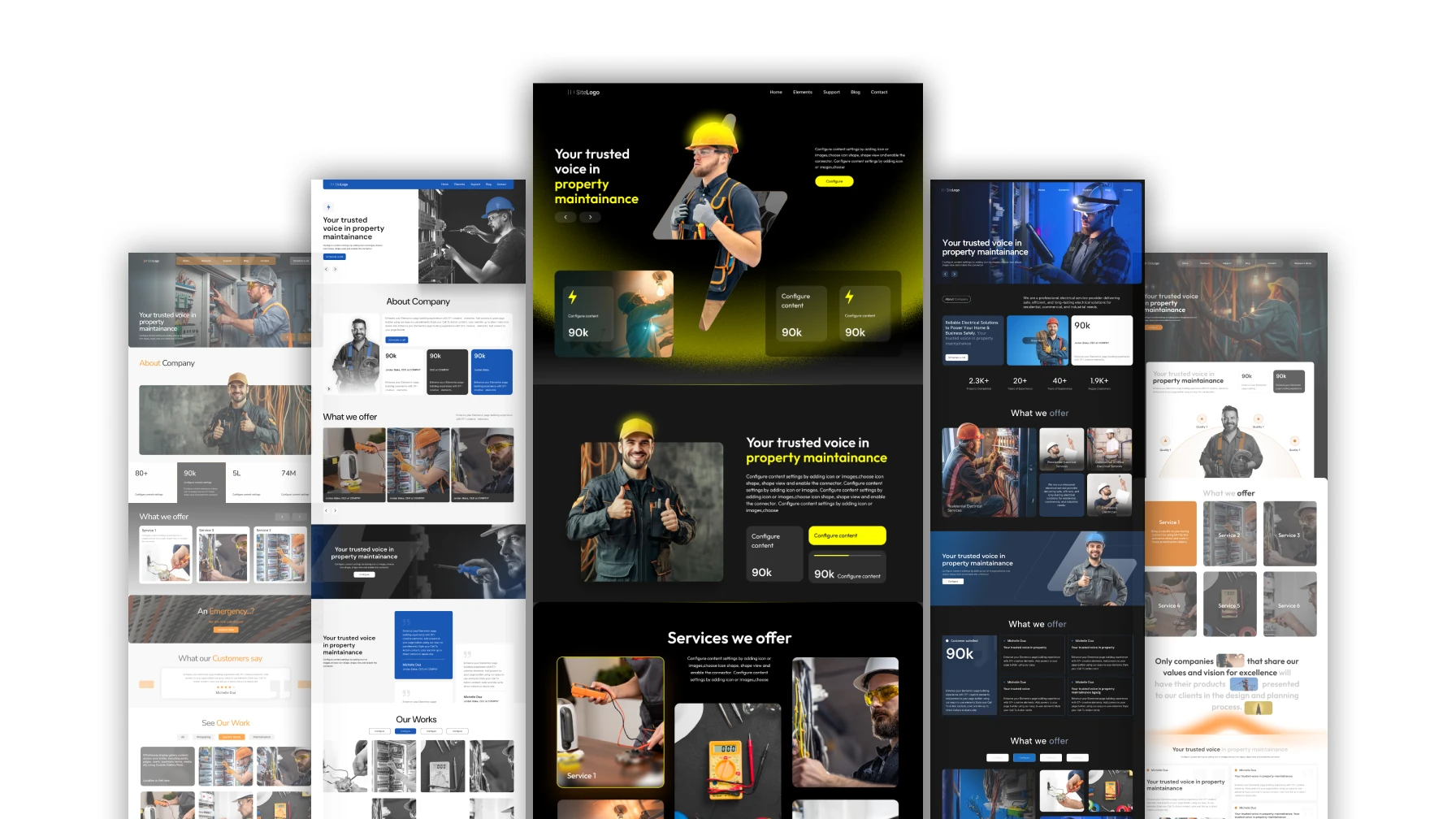
Most homeowners decide whether to call you within 30 seconds of landing on your About Us page. They are not reading for fun. They are checking if you are real, qualified, and the kind of person they want inside their home.
A good about us page electrician owners can be proud of does three things: it shows the human behind the business, it answers the trust questions a customer is silently asking, and it makes booking the next step feel easy. This guide walks through exactly how to write one — including before-and-after rewrites of weak About pages so you can see the difference.
What Customers Are Really Looking For on Your About Page
Before writing anything, understand what the visitor is doing. They are not learning about you out of curiosity. They are screening you.
In the Dutch market in particular, where complaints about unqualified or fraudulent installers have hit record levels, customers are looking for proof that you are legitimate before they pick up the phone. That means certifications, real photos, named team members, and clear values.
A strong About page covers six things:
- Why you started the business (origin story)
- Who is on the team (with names and faces)
- Certifications and memberships (Techniek Nederland, KvK number, REI/VCA, etc.)
- Values that matter to customers (punctuality, cleanliness, transparent pricing)
- A personal note from the founder
- Clear next step (call, book, request a quote)
Step 1: Write a Short, Honest Origin Story
Start with why the business exists. Not the corporate version — the real one.
The mistake most electricians make is writing something like “Founded in 2008, we have grown to become one of the leading electrical contractors in the region.” That tells the customer nothing. It sounds like every other website.
Instead, answer two questions:
- Why did you start this business?
- What kind of work do you actually enjoy doing?
Keep it to 80–150 words. One short paragraph, written like you would explain it to a neighbour over coffee.
Weak version:
“ABC Elektrotechniek is a full-service electrical contractor providing comprehensive solutions to residential and commercial clients across the Netherlands.”
Stronger version:
“I started ABC Elektrotechniek in 2014 after ten years working for a large installation company. I kept seeing the same problem: customers waiting weeks for a quote, then waiting weeks more for the work. I wanted to run a small team that shows up on time, leaves the house clean, and answers the phone when you call. That is still how we work today.”
Notice the second version names the founder, gives a real reason, and sets expectations the customer can hold you to.
Step 2: Show the Team With Names and Photos
Stock photos of unnamed electricians in clean uniforms hurt your credibility. Customers can spot them instantly, and they signal exactly the kind of fly-by-night operation people are trying to avoid.
A team page tradesperson visitors can trust includes:
- A real photo of each team member (in your actual uniform, in a real setting)
- First name and role (Pieter — Senior Electrician, Sara — Apprentice, etc.)
- One short line of context per person (“12 years in residential work” or “Specialises in EV charger installations”)
If you are a solo electrician, this still applies. One clear photo of you, your name, and your role. Customers want to know who is showing up at their door.
Step 3: List Your Certifications and Memberships Clearly
This is where you remove doubt. Most electricians have the credentials but bury them in a footer or skip them entirely.
Put them in a clear, scannable block on the About page. Include:
- KvK (Chamber of Commerce) number
- BTW number
- Trade memberships (Techniek Nederland, UNETO-VNI, etc.)
- Safety certifications (VCA, NEN 1010, NEN 3140)
- Specialist accreditations (Solar Keymark, EV charger installer certification, manufacturer partnerships)
- Insurance details (general liability cover)
You do not need to explain each one in detail. A simple list with logos where possible is enough. Customers who care about a specific certification will recognise it. Customers who do not care will still see a long list and feel reassured.
Step 4: Write Down the Values Customers Actually Care About
“Quality, integrity, and excellence” mean nothing. Every business claims them. Customers tune them out.
The values that move a customer from undecided to booking are the ones tied to specific frustrations they have had with other electricians. Things like:
- Punctuality — “We arrive within the agreed time window or we call you in advance.”
- Cleanliness — “We use shoe covers and dust sheets. We clean up before we leave.”
- Transparent pricing — “You get a fixed quote before we start. No surprise charges.”
- Honest advice — “If a repair is cheaper than a replacement, we will tell you.”
- Communication — “We answer the phone or call back within two hours during business hours.”
Pick three or four. Write each as a promise, not an adjective. A promise is something the customer can hold you to. An adjective is just marketing.
Step 5: Add a Personal Note From the Founder
This is the section most electricians skip, and it is the one that does the most work.
A short founder note (100–150 words) gives the customer a face to associate with the business. Even if you have a team of ten, customers want to know who is in charge.
Include:
- Your name and a real photo (not a logo)
- Why you take this work personally
- One thing you want every customer to know
- A signature (handwritten if possible)
Example:
“Hi, I’m Marco. I have been an electrician for 18 years. The reason I run this business the way I do is simple — my own father was once overcharged for a small fuse box repair, and it stuck with me. Every quote we send is one I would be comfortable giving to my own family. If something is wrong with the work we do, call me directly and I will make it right. — Marco van der Berg”
That paragraph tells the customer more than a polished company history ever will.
Step 6: End With a Clear Next Step
The About page is not the end of the journey. It is the moment the customer decides whether to take the next step. Make it obvious what that step is.
Avoid vague phrases like “Get in touch.” Use a specific, low-friction action:
- “Request a quote — we reply within four hours.”
- “Book a free home visit.”
- “Call us on [number] — Monday to Friday, 8:00 to 18:00.”
If your website has an enquiry or booking form, link to it directly. Every minute the customer spends figuring out how to contact you is a minute they might spend contacting your competitor instead.
Three Before-and-After Rewrites
Here are three weak About pages, rewritten using the framework above. These are based on common patterns we see, not real businesses.
Rewrite 1: The Generic Corporate Bio
Before:
“Established in 2010, XYZ Electrical Services is a leading provider of innovative electrical solutions, committed to delivering excellence to every client. Our experienced team of professionals offers a comprehensive range of services tailored to meet your needs.”
After:
“XYZ Electrical Services started in 2010 as a one-man operation in Utrecht. Today we are a team of four electricians serving homeowners across the Randstad. We focus on three things: replacing old fuse boxes, installing EV chargers, and emergency callouts within 24 hours. We are members of Techniek Nederland and fully insured. Our founder, Jan de Vries, still goes out on jobs every week.”
Rewrite 2: The “We Do Everything” Page
Before:
“We offer a full suite of electrical services including but not limited to residential, commercial, and industrial installations, repairs, maintenance, and consultations. Our state-of-the-art equipment and highly trained staff ensure top-quality results every time.”
After:
“We work on residential properties only — houses, apartments, and small renovations. That focus lets us be fast and consistent. Most of our work falls into four categories: rewiring older homes, installing solar inverters, fitting EV chargers, and replacing fuse boxes. If your job is outside this list, we will tell you honestly and recommend someone better suited.”
Rewrite 3: The Anonymous Team Page
Before:
“Our skilled team of certified electricians is dedicated to providing you with the highest level of service. Each member brings years of experience and a passion for excellence to every project.”
After:
“Our team is small on purpose — three electricians and one office coordinator. Tom (founder) has 22 years of experience and handles complex installations. Lisa specialises in solar and battery systems. Ahmed is our newest electrician, certified in EV charger installation. Sandra schedules every job and is the person who picks up when you call. You will see the same faces from quote to completion.”
Where the About Page Fits Into Your Wider Site
The About page is one part of a working website. It builds trust, but the customer still needs an easy way to act on it. That usually means a contact form, a booking option, or a clear phone number — and a way to manage the enquiries that come through.
If enquiries come in faster than you can keep up with, they get lost. If they get lost, the trust you built on the About page is wasted. Growth Rocket pairs a professional website with the Growth Rocket Hub, where every enquiry, booking, and follow-up is organised in one place. The website brings the customer in. The Hub keeps you on top of what happens next.
Frequently Asked Questions
How long should an electrician’s About Us page be?
Aim for 400–700 words of body copy, plus team photos and a certifications block. Long enough to cover the six trust signals, short enough that nothing gets skipped.
Should I include my prices on the About page?
Not full pricing, but a sentence on how you handle pricing helps. Something like “We give a fixed quote before any work starts” addresses the most common customer concern without committing you to numbers.
Do I need a professional photographer?
For team and founder photos, yes — or at least someone with a decent camera and natural light. Phone photos work if they are well-lit and clearly show the person’s face. Avoid stock photos entirely.
What if I work alone?
A solo electrician’s About page is often stronger than a team page, because the customer knows exactly who is showing up. Lead with your name, photo, years of experience, and the type of work you focus on.
Should I list customer reviews on the About page?
A small number (two or three) can work well at the bottom of the page. Full review sections belong on a separate page or homepage so the About page stays focused on you and your team.
How often should I update the About page?
Review it once a year. Update team photos when staff changes, add new certifications when you earn them, and refresh the founder note if your focus has shifted.
Putting It All Together
A good About Us page is not about clever writing. It is about answering the silent questions a customer is asking before they call: Who are you? Are you qualified? Will you treat my house with respect? What happens if something goes wrong?
Cover those clearly, with real names, real photos, real certifications, and a personal note from the founder, and your About page will do its job.
Then make sure the website around it is fast, mobile-friendly, and easy to contact you through. That is where most electrician websites fall down — not in the writing, but in the structure.